
Anime can teach you Japanese.
That is not the problem.
You can learn vocabulary from anime. You can improve listening. You can become familiar with sentence endings, casual contractions, emotional expressions and different speaking styles. For many learners, anime is also the reason they spend hundreds or thousands of hours listening to Japanese in the first place.
All of that matters.
But there is a different question:
If your goal is to actually talk to people in Japanese, what kind of language should form the foundation of your learning?
The answer is not anime.
It is real conversation.
Not because anime Japanese is “fake,” and not because everything said in anime would sound strange in real life.
The reason is more fundamental.
Anime dialogue is created to tell a story.
Real conversation is created to manage a relationship, achieve something, respond to another person and keep an interaction moving.
Those are different systems.
And if your goal is to use Japanese with real people, you should spend more time learning from the system you will eventually need to participate in.
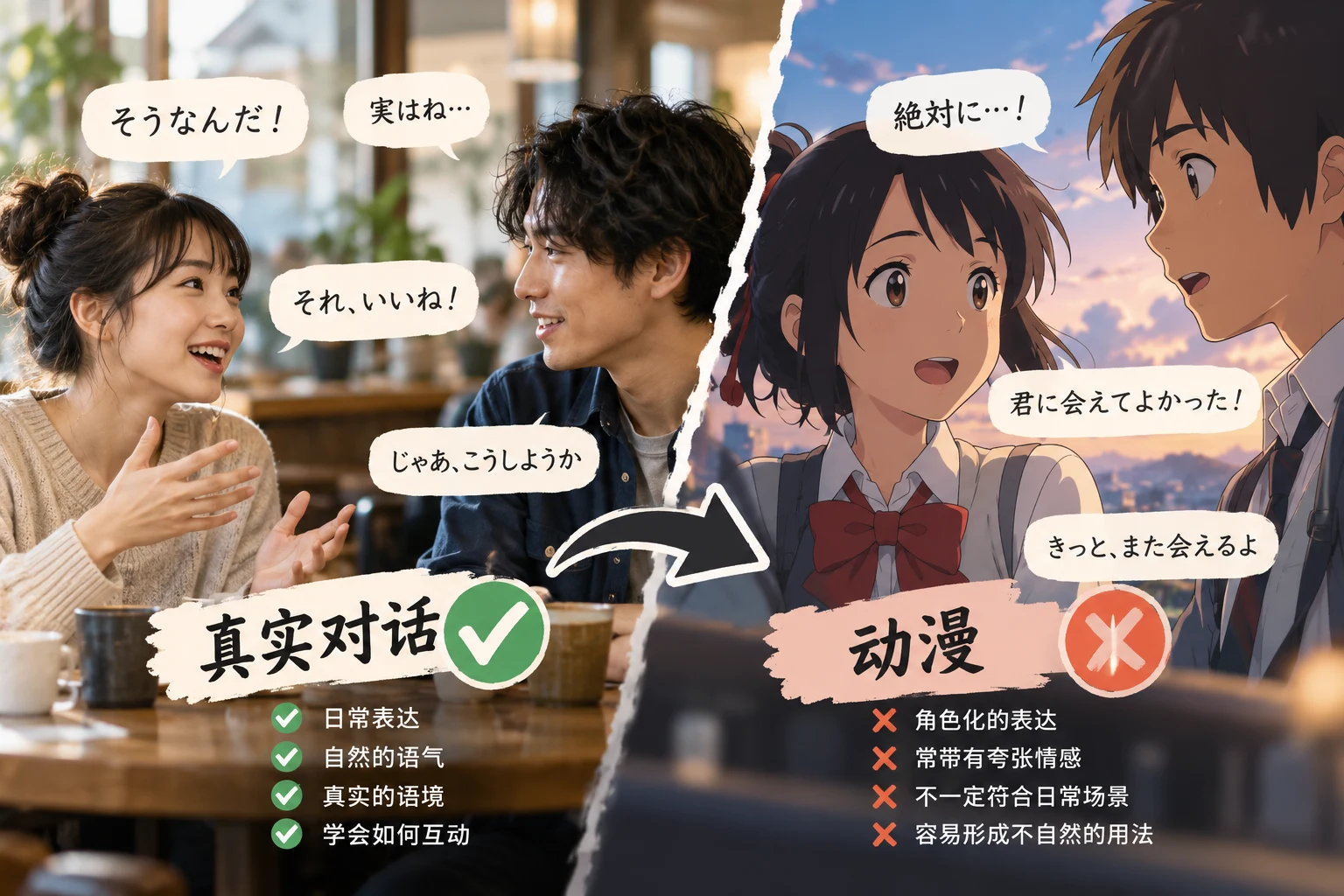
Anime contains Japanese. Conversation contains interaction.
Consider a perfectly ordinary sentence:
ちょっと難しいですね。
Its dictionary meaning is simple:
“That's a little difficult.”
But what does it actually mean?
A teacher might literally be describing the difficulty of an assignment.
A coworker might be politely saying that a deadline is impossible.
A shop employee might be indirectly telling you that your request cannot be accommodated.
A friend might be expressing hesitation without rejecting your suggestion outright.
The words alone do not tell you enough.
The meaning comes from the relationship between the speakers, what happened immediately before, tone of voice, timing, facial expression and what the other person does next.
This is one of the central problems in language learning.
We often study sentences, while real communication happens through interactions.
Anime gives you many sentences.
Real conversation shows you what those sentences are doing.
Real people rarely speak in complete textbook sentences
Learners are often surprised by ordinary Japanese conversations.
Not because the grammar is advanced.
Because there seem to be fewer complete sentences than expected.
Someone says:
これ、どうします?
Another person replies:
あ、それはこっちで。
Then:
あ、わかりました。
Then:
すみません、お願いします。
From a textbook perspective, information is missing everywhere.
Who is doing what?
What exactly does こっちで mean?
Why is お願いします enough?
Why does nobody explain the subject?
Because the speakers share a situation.
They can see the same object.
They know what task they are discussing.
They know who is responsible for what.
Real conversation therefore contains enormous amounts of language whose meaning depends on context.
And this is exactly the kind of language learners need to become comfortable with.
If you learn mainly from sentences removed from situations, you may become very good at understanding explicit language while continuing to struggle with ordinary conversation, where much of the message is never stated.
Conversation teaches you when not to say something
Language learning usually focuses on production:
What should I say?
But natural communication also depends on knowing what does not need to be said.
Japanese makes this particularly noticeable.
Subjects disappear.
Objects disappear.
Previously mentioned information disappears.
Entire conclusions may be left implicit.
A learner may produce a sentence that is grammatically flawless but unnecessarily explicit because they are saying information that everyone in the situation already understands.
The problem is not grammar.
It is discourse.
Real conversation repeatedly teaches you how much information speakers normally make explicit.
Anime sometimes contains this too, of course.
But scripted storytelling has another obligation: the audience has to understand what is happening.
Characters may therefore verbalize information partly for the viewer's benefit.
Real people do not have an audience.
They only need to communicate with each other.
That difference matters.
You need to learn the machinery between sentences
When learners think about speaking Japanese, they usually think about vocabulary, grammar and pronunciation.
But conversation contains another layer.
Consider:
うん。
へえ。
そうなんだ。
なるほど。
え、ほんと?
まあね。
たしかに。
そっか。
None of these is especially difficult.
Yet using them naturally is difficult.
You need to know when to respond.
How quickly.
With what intonation.
Whether you are showing agreement, surprise, sympathy or simply attention.
Whether silence would feel normal.
Whether the other person has finished speaking.
Whether they are inviting you to take the next turn.
This is interactional competence.
A person can know a great deal of Japanese grammar and still be uncomfortable in conversation because they have not learned how conversation itself is organized.
Real dialogue exposes you to this constantly.
People interrupt.
They overlap.
They hesitate.
They restart sentences.
They misunderstand each other.
They ask for clarification.
They repair what they just said.
They react while another person is speaking.
They abandon sentences halfway through because the listener already understands.
These are not defects in language.
They are part of language.
A fluent conversation is not two perfect monologues
Educational materials often clean speech up.
That makes sense when the objective is comprehension.
But it can also create a distorted mental model of spoken language.
Learners begin expecting something like:
Person A speaks.
Person A completes a grammatical sentence.
Person B waits.
Person B responds with another complete sentence.
Real interaction is much messier.
A speaker begins:
昨日のあれなんだけど……
The other person already knows:
ああ、はいはい。
The first speaker continues:
やっぱり来週にしようかなって。
Then:
あー、そのほうがいいかも。
Nobody needed a beautifully structured paragraph.
Both participants continuously predicted what the other person meant.
Learning to participate in conversation therefore requires more than decoding complete utterances.
You need experience predicting incomplete ones.
Real conversations teach frequency
Suppose you learn 10,000 Japanese expressions.
That sounds impressive.
But those expressions do not have equal value.
Some may appear repeatedly throughout your life.
Others may appear once every few years.
This is another reason real-world material matters.
Everyday interaction naturally reveals which expressions people repeatedly rely on to accomplish common communicative tasks:
asking someone to wait,
softening disagreement,
checking understanding,
requesting clarification,
changing topics,
making suggestions,
accepting something reluctantly,
declining without creating unnecessary tension,
showing that you are following a story.
The same structures appear again and again because human situations repeat.
This repetition is valuable.
It teaches you not only what Japanese can say, but what Japanese speakers repeatedly choose to say.
That distinction is essential for naturalness.
Correct Japanese and probable Japanese are different things
Grammar tells you whether a sentence is possible.
Real usage tells you whether people normally choose it.
These are not identical.
A learner can construct a sentence that is completely grammatical and completely understandable, yet unusual enough that a proficient speaker would almost certainly have expressed the same thought differently.
This happens because fluent speakers do not generate language by selecting isolated words and applying grammar rules to them one by one.
A large amount of everyday speech is built from familiar patterns.
Things like:
〜って感じ
〜んだけど
〜てもらっていい?
そういうことじゃなくて
なんていうか
たしかにそうなんだけど
The important learning object is often not one word.
It is an entire recurring piece of language connected to a communicative function.
The more authentic conversation you hear, the more evidence your brain receives about which combinations actually recur.
That gradually changes your question from:
“Can I construct this sentence?”
to:
“Is this how people normally say this?”
That is one of the transitions from correct language to natural language.
Anime has a different optimization problem
Anime dialogue has to accomplish things ordinary conversation does not.
A character needs to become recognizable quickly.
Personality needs to be audible.
Age, gender, confidence, social status, regional identity or archetype may need to be communicated through speech.
An arrogant character should sound arrogant.
A mysterious character should sound mysterious.
A child should sound recognizably childlike.
A historical warrior should not sound like an ordinary office worker.
Japanese is particularly rich in linguistic resources that can help writers accomplish this.
Pronouns.
Sentence-final particles.
Dialect.
Verb forms.
Vocabulary choices.
Speech styles.
These can become signals for the kind of person the audience is supposed to imagine.
This is often described as role language.
Role language is not completely disconnected from reality.
Its effectiveness depends precisely on the audience having real social associations with particular ways of speaking.
But fiction can concentrate, exaggerate and combine those associations.
That is useful for characterization.
It is much less useful if a learner simply copies the character without understanding what social information the speech carries.
The dangerous part is not understanding anime Japanese
Understanding unusual language is useful.
The risk appears when recognition becomes imitation without calibration.
Imagine hearing an expression hundreds of times from a certain type of character.
Frequency inside your personal input makes it feel normal.
But what you have learned is:
This expression appears frequently in the content I watch.
You have not necessarily learned:
People like me frequently use this expression with people like the person I am talking to in situations like this one.
Those are completely different kinds of knowledge.
Real-world language depends heavily on the second one.
Who says it?
To whom?
At work or at home?
To a friend or a stranger?
Seriously or jokingly?
When angry?
When trying to sound masculine?
When deliberately being cute?
When performing a character?
Without that information, copying media speech can produce something technically understandable but pragmatically strange.
That problem has been observed specifically among learners who acquire contemporary Japanese from media without enough guidance: an expression may be linguistically recognizable while being socially inappropriate in the learner's actual situation.
Real conversation contains consequences
There is another advantage authentic interaction has that recorded entertainment cannot completely reproduce.
The listener responds.
Suppose you phrase a request strangely.
The other person hesitates.
You immediately receive information.
Perhaps they misunderstood.
Perhaps the request sounded stronger than you intended.
Perhaps the wording was unusual.
Perhaps you chose the wrong level of politeness.
Real communication creates a feedback loop:
say something → observe the reaction → adjust
That loop is extraordinarily informative.
Conversation research has repeatedly shown why interaction matters for language development: communication creates opportunities for learners to notice misunderstandings, negotiate meaning, modify what they say and receive feedback.
A television character never responds to you.
A real interlocutor does.
Even watching real conversation can teach you things anime cannot
This does not mean you need a Japanese friend standing beside you every time you study.
There is a useful middle ground between textbook dialogue and live interaction.
Watch real people talking to each other.
Interviews.
Vlogs.
Street conversations.
Podcasts with multiple speakers.
Workplace videos.
Reality content.
Casual livestreams.
Recorded conversations.
What matters is not merely that native speakers appear in the video.
What matters is that they are actually trying to communicate something to each other rather than performing predetermined dialogue for a fictional story.
Now you can observe:
Who begins the conversation?
How does the other person acknowledge them?
Where do they hesitate?
Which sentences are abandoned?
How do they disagree?
How do they change topic?
When do they laugh?
What do they leave unsaid?
What triggers そうなんですね rather than そうですか?
When does someone switch from です・ます to a more casual style?
That is language learning at the level of interaction.
But anime is still valuable
None of this means you should stop watching anime.
That would throw away something important.
Enjoyment matters enormously in language learning.
Material you genuinely want to watch can expose you to hundreds of hours of Japanese that you would never tolerate in a traditional course.
Narrative context also helps expressions become memorable.
Characters create strong voices.
Repeated situations create repetition.
Audiovisual material can contribute to vocabulary, listening, pronunciation awareness and other areas of second-language development.
The mistake is not learning from anime.
The mistake is asking anime to do a job it was never designed to do.
If your goal is to understand anime, anime is obviously excellent input.
If your goal is to discuss anime with friends, it remains extremely relevant input.
If your goal is to work in Japan, build relationships, speak to teachers, deal with a landlord, join meetings, visit a clinic or simply have comfortable everyday conversations, then those communicative environments need to appear somewhere in your learning.
Content should reflect the ability you eventually want.
Some anime is much closer to real conversation than others
“Anime Japanese” is also too broad a category.
A quiet contemporary story about university students is not linguistically equivalent to a fantasy series involving ancient demons, aristocrats and supernatural warriors.
Different genres create different distances from ordinary interaction.
Some characters speak relatively natural contemporary Japanese.
Others are deliberately stylized.
The useful question is therefore not:
Is anime authentic Japanese?
It is:
Authentic to what?
A sentence can be authentic to a fictional character.
Authentic to a genre.
Authentic to youth slang.
Authentic to one regional identity.
Authentic to joking between close friends.
And still be inappropriate for the conversation you personally need to have tomorrow morning.
Language has no universal “natural” form independent of situation.
Naturalness always belongs to a context.
Build your foundation from the situations you want to enter
A better strategy begins with your real target.
Suppose you want to work in Japan.
Then your core input should contain people doing things such as:
introducing themselves,
asking questions,
requesting help,
clarifying instructions,
making small talk,
explaining problems,
disagreeing politely,
giving updates,
speaking to customers,
talking to coworkers.
Suppose you want Japanese friends.
Then you need casual conversation:
telling stories,
reacting,
teasing,
inviting,
declining,
changing plans,
showing sympathy,
complaining,
sharing opinions.
Suppose you want to attend a Japanese university.
You need another distribution again:
seminars,
student conversations,
presentations,
questions,
group work,
administrative interactions.
The principle is simple:
Practice language inside the kinds of situations where you eventually want to use it.
This sounds obvious.
But a surprising amount of language education does the opposite.
Learners spend years studying decontextualized material and hope that real-world competence will somehow emerge afterwards.
A better hierarchy of input
You do not have to choose one source.
Think instead in layers.
Foundation: real interaction
Use real conversations to learn how people actually coordinate meaning.
This teaches you frequency, timing, social distance, turn-taking, repair, hesitation and pragmatic choices.
Structured support: educational material
Use dictionaries, grammar explanations and learning tools to understand what you encounter.
These materials make difficult input accessible.
Expanded input: fiction and entertainment
Use anime, dramas, films, games and other media to increase exposure, enjoyment, vocabulary breadth and stylistic awareness.
Now each source does the job it is best at.
The problem disappears once entertainment stops being your only model of human interaction.
How to learn from a real conversation
You also do not need to study every second of a twenty-minute conversation.
Choose a short scene.
Perhaps thirty seconds.
First, watch it normally.
Understand what is happening.
Then watch again and stop asking only:
What do these words mean?
Ask different questions.
Why did this person say it this way?
Why did they stop there?
Why did the other person respond immediately?
What information was omitted?
Was that actually agreement, or only acknowledgment?
Why did the speaker soften the statement?
What expression appears as one familiar chunk?
Could I use it in my own life?
Then replay the scene.
Imitate it.
Try producing the same communicative function with different information.
If the original speaker says:
明日はちょっと難しいですね。
try:
今週はちょっと難しいですね。
Then imagine another situation.
A meeting.
Dinner.
A request.
You are no longer memorizing dialogue.
You are extracting a reusable interactional pattern.
Learn language together with its conditions
This suggests a richer way to save something you encounter.
Instead of learning:
結構です = no thank you
learn:
expression: 結構です meaning here: politely declining speaker: customer listener: service staff relationship: strangers tone: neutral/polite situation: offered something unnecessary possible alternative: 大丈夫です what happened next: staff accepted the refusal immediately
The additional information may look excessive.
But much of what makes language natural lives exactly there.
A dictionary records semantic meaning.
A learner eventually needs situational meaning.
This is especially important for Japanese
All languages encode social information, but Japanese makes the problem difficult to ignore.
Pronouns can carry identity.
Sentence endings can change stance.
Politeness changes relationships.
Verb choices can encode respect.
Subjects are routinely omitted.
A tiny response can communicate attention without agreement.
Silence can do communicative work.
An expression that is perfect with a close friend may be uncomfortable with a professor.
That means learning Japanese cannot eventually remain a mapping between:
Japanese sentence → translation
The learner needs another mapping:
situation → relationship → intention → likely Japanese expression
Real conversations give you repeated examples of that mapping.
And repeated examples are how your intuitions gradually become better.
Your goal is not to speak like content
There is a useful question to ask whenever you encounter an interesting expression:
Who do I become if I speak this way?
Not just:
What does it mean?
Not just:
Is the grammar correct?
But:
What kind of person normally says this?
What relationship does it imply?
What emotional stance does it communicate?
Would I say it to my teacher?
My manager?
A stranger?
A close friend?
Would someone my age say it?
Would they say it seriously?
This question turns anime from a dangerous model into a useful linguistic laboratory.
You can observe stylization precisely because you already possess a baseline of real conversational Japanese.
The better you know ordinary speech, the more interesting fictional speech becomes.
You can see what the writer is changing.
Real Japanese first. Stylized Japanese second.
The choice between conversation and anime is therefore not really a choice between boring material and interesting material.
It is a question of order.
If your primary model is fictional, you have to infer which parts transfer to life.
If your primary model is real conversation, you gain a baseline.
Anime can then expand that baseline.
You can enjoy dialects.
Character voices.
Historical styles.
Youth language.
Exaggeration.
Humor.
Wordplay.
Fantasy vocabulary.
You know that these are variations on Japanese rather than your only evidence for how Japanese works.
That is a much safer and much richer position.
At Mimora, this is one reason we think context should remain attached to the language a learner encounters.
A word is not simply a word.
A sentence is not simply a sentence.
Who said it, in what situation, with what intention and what happened around it are part of what the learner is actually trying to acquire.
Because ultimately, most people are not learning Japanese in order to produce Japanese sentences.
They are learning Japanese in order to do things with other people.
To understand.
To respond.
To belong.
To work.
To joke.
To disagree.
To ask for help.
To build relationships.
Anime can be an extraordinary part of that journey.
But if the destination is real conversation, then real conversation should be part of the road from the beginning.