
For decades, language learning has been organised around a simple assumption: someone should decide what you need to learn, arrange it in the right order, and then teach it to you. Lesson 1 comes before Lesson 2. Beginner vocabulary comes before intermediate vocabulary. Grammar is divided into chapters, and progress means moving forward through a course. That model made sense when learning materials were scarce. That world is disappearing.
A learner today can open YouTube and hear more natural Japanese in an evening than a textbook could contain in hundreds of pages. Podcasts, interviews, livestreams, dramas, news reports, social media and online communities provide an effectively unlimited amount of authentic language. Artificial intelligence can explain an unfamiliar sentence instantly. Dictionaries identify a word with one click. Speech recognition can evaluate pronunciation. Translation is available almost everywhere.
The problem is no longer access to language. The new problem is what to do with all of it — and that changes the basic architecture of language learning.
The old paradigm starts with the curriculum
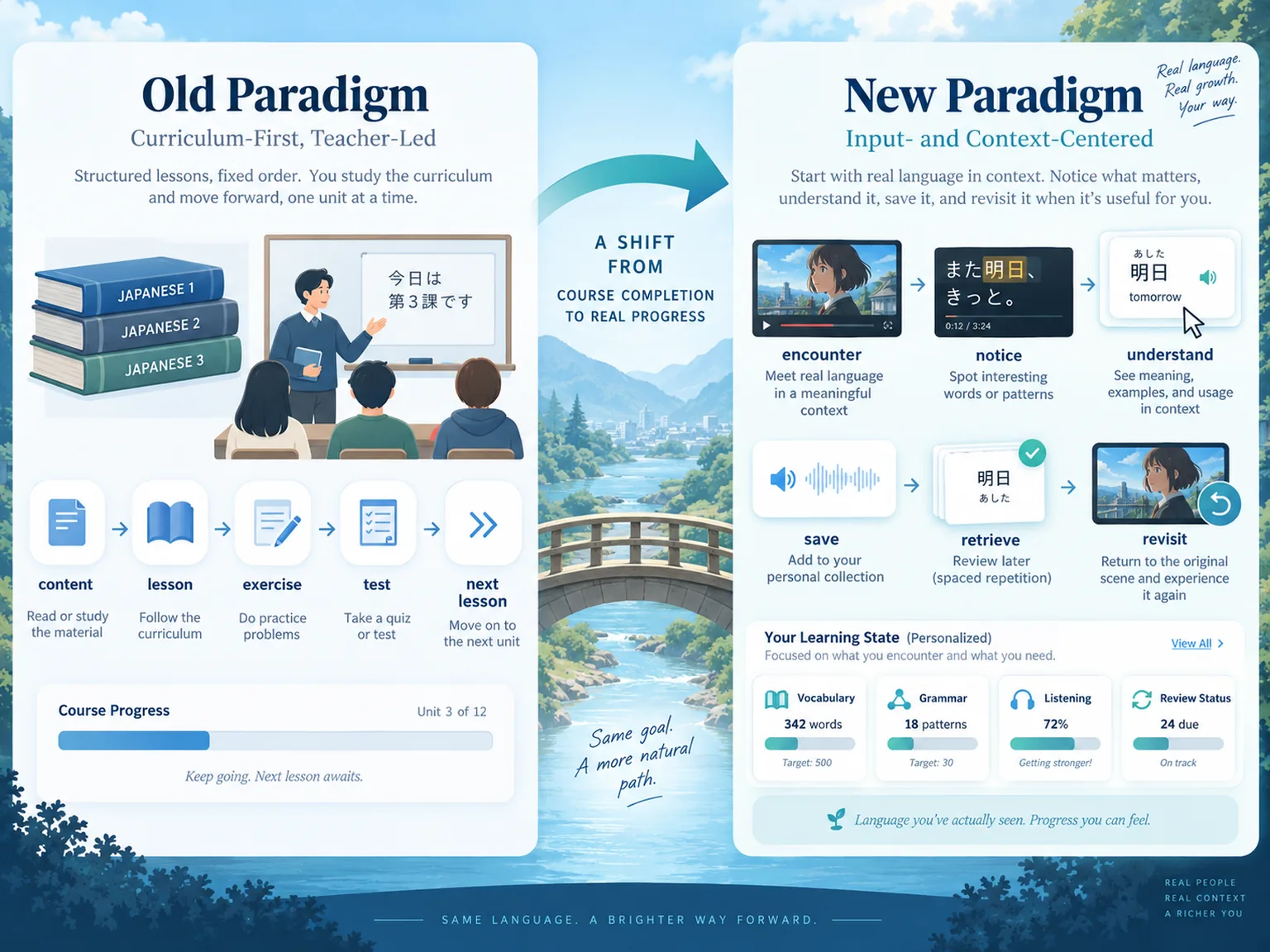
Traditional language education is curriculum-first. A course defines a sequence, and the learner moves through material selected in advance.
content → lesson → exercise → test → next lesson
This has real advantages. A well-designed curriculum can prevent obvious knowledge gaps, introduce difficult concepts gradually, and give beginners a clear sense of direction. But it also makes a strong assumption: that the same sequence is a reasonable sequence for most learners.
Real language use is not organised that way. Someone learning Japanese because they work in a restaurant encounters a different language from someone studying engineering. A person watching gaming streams repeatedly meets vocabulary that may never appear in a general textbook. Someone living in Japan may suddenly need to understand apartment contracts, hospital conversations or workplace expressions long before a curriculum says they are ready.
The language that matters most to a learner increasingly comes from the learner’s life, not from the next chapter of a book. That suggests a different starting point. Instead of asking what lesson the learner should study next, we can ask what language this learner is actually encountering, understanding, forgetting and needing. That is a much deeper change than replacing a textbook with an app.
From lessons to encounters
The fundamental unit of traditional learning is the lesson. The fundamental unit of the emerging model may be the encounter.
Imagine hearing このままだと間に合わないよ in a Japanese video. You do not fully understand it, so you pause. You inspect 間に合う. You understand the sentence. Then the video continues.
In most digital learning systems the important event ends there: the dictionary lookup solved the immediate comprehension problem. But from a learning perspective something much more valuable just happened. You encountered a word spoken by a particular person, in a particular sentence, with a particular intonation, inside a meaningful situation, at a moment when you personally wanted to understand it.
That is not merely a vocabulary item. It is a learning event — and a future learning system does not have to throw it away. It can preserve it.
From storing words to preserving context
Language-learning software has traditionally converted knowledge into increasingly smaller objects. A sentence becomes a vocabulary item; the vocabulary item becomes 間に合う = to be in time. This makes information easier to store and test, and flashcards are powerful partly because of that abstraction.
But abstraction has a cost. The learner originally met 間に合う inside a scene, a voice, a sentence and a communicative intention. Once reduced to a word-definition pair, most of that information disappears. The next generation of systems can afford to preserve far more of the original event.
word → sentence → audio → speaker → timestamp → video → situation
Review no longer has to mean looking at a disconnected card. It can mean returning to the moment where the knowledge originally mattered. This does not make flashcards obsolete — retrieval practice and spaced repetition remain powerful mechanisms. What changes is what gets retrieved. Instead of repeatedly retrieving an isolated translation, learners can retrieve language together with the context it was used in. The distinction matters, because knowing what a word means is not the same as recognising it instantly when somebody says it.
From content delivery to a learning loop
Most educational software still behaves like a content library: it gives learners things to consume. A more useful model is a loop.
encounter → notice → understand → save → forget → retrieve → revisit → encounter again
The final step is the important one. Learning should not always terminate inside the learning system. If a learner discovered a phrase in a video, the system can eventually send them back to that video, and the sentence that was incomprehensible a week ago may suddenly feel obvious. That moment gives the learner something a vocabulary score cannot: evidence that their perception of real language has changed.
The material becomes both the source of knowledge and the place where progress becomes visible. Videos stop being entertainment used as supplementary input, and become part of the learner’s memory structure.
From a fixed sequence to a learner state
There is another limitation in course-based learning. Courses know where the curriculum is. They do not necessarily know where the learner is.
Two people can complete exactly the same ten lessons and emerge with very different knowledge. One remembers most of the vocabulary but struggles with listening. Another understands speech well but misses grammar. A third knows the material but has not met it often enough in natural situations to process it quickly. "Lesson 10 completed" is a poor description of a learner.
A more useful system maintains a changing model of the learner’s state. What has this person encountered? What do they recognise? What have they forgotten? Which grammar repeatedly causes difficulty? Which words appear across several videos? Which material is becoming too easy? Which situations have they barely experienced?
Once those questions become answerable, learning paths no longer need to be identical. The curriculum stops being a fixed road and becomes a navigation system.
AI changes the coordination problem
This is where AI may matter more than simply providing a chatbot. Much of the first generation of AI language-learning products has focused on generation: generate an explanation, an exercise, a dialogue, a lesson. Those capabilities are useful, but generation alone does not change the learning model. A machine-generated worksheet is still a worksheet.
The larger opportunity is coordination. An intelligent system can connect information that was previously scattered across different tools: what you watched yesterday, what you saved three weeks ago, what you consistently misunderstand, what you have already mastered, what appears in the video you are watching now, and what you are likely to benefit from meeting next.
AI then becomes less like an endlessly talking teacher and more like a layer that organises a continuously changing learning environment.
Given everything I have already encountered, what should I pay attention to next?
That is a harder question than what AI can teach me — and a much more interesting one.
The future is not “no curriculum”
A paradigm shift does not mean everything that came before was wrong. Beginners still need structure. Grammar explanations still matter. Deliberate vocabulary practice still matters. Retrieval practice still matters. Teachers still matter. Interaction and language production still matter. And authentic content alone does not guarantee learning: watching thousands of hours of incomprehensible television is not a learning strategy.
The change is in the relationship between these components. A textbook-centred model says: study this first, so that one day you can understand the real world. An input-centred model increasingly says: enter the real world earlier, and build structured learning around what happens there. Formal instruction becomes support for authentic language rather than a prerequisite for encountering it.
A different definition of progress
This also changes what progress means. Traditional systems are good at measuring what learners have completed: 27 lessons, 1,200 words, 43 grammar points, 86 per cent of a course. Those numbers are convenient because they are easy to count. But learners rarely start studying Japanese because they want to complete 86 per cent of a curriculum.
They want something closer to this. A video that once required subtitles no longer does. A sentence that once sounded impossibly fast becomes obvious. A phrase heard months ago appears in a conversation and is understood immediately. An unfamiliar topic becomes accessible. The learner can take part in situations that previously excluded them.
Progress is ultimately a change in what the world allows you to understand and do, and learning systems should become better at representing that change.
Language learning may become less visible
There is a paradox here. As language-learning technology becomes more sophisticated, the act of studying a language may become less separate from using it. Instead of opening a course, studying for thirty minutes and then returning to normal life, learning can be distributed through ordinary encounters.
Watch something. Become curious about a sentence. Understand it. Keep something useful. Continue watching. Meet it again later. Review it when necessary. Eventually stop needing help. In that model, the boundary between learning Japanese and using Japanese becomes increasingly difficult to locate — and that may be the most important shift of all.
From a library of lessons to a memory of your language life
At Mimora this is the direction we are exploring. Rather than treating every video as disposable input, we think a learning system can remember the relationship between the learner and the content: which video introduced a word, which sentence made it meaningful, what was saved, what needs review, and where that knowledge originally came from.
But the broader idea is not specific to one product. Language-learning technology is gradually moving from systems designed to deliver educational content toward systems capable of organising a learner’s own encounters with a language. That changes the central question of language education.
What has this learner experienced, and what should happen to that experience next?
For a long time we asked what we should teach the learner. The next generation of language-learning systems may increasingly ask the question above instead. That is not merely a new feature. It is a different learning paradigm.